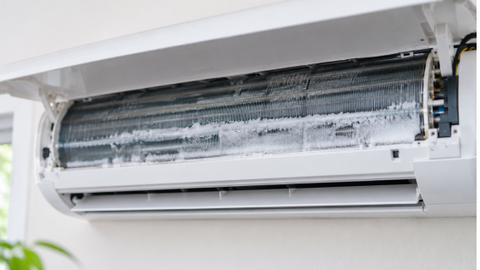



Your mini split stops cooling properly. A technician adds refrigerant, and the room feels comfortable again. Then, days or weeks later, cooling weakens and ice returns to the indoor unit.
Was the repair unsuccessful—or does the system simply need another recharge?
A mini split that freezes again after a refrigerant recharge may have an unresolved refrigerant leak, an incorrect system charge, or an airflow problem. Adding refrigerant can temporarily restore cooling, but it cannot repair a leak. The underlying cause must be identified before another recharge can provide a lasting solution.
Why a Recharge Can Seem to Fix the Problem
When refrigerant levels are too low, restoring the correct charge can improve cooling performance. However, that improvement does not tell you whether the system can maintain the correct charge over time.
Think of the difference between replacing what escaped and fixing the place it escaped from. Both may be necessary, but they are separate tasks. EPA guidance encourages homeowners to have refrigerant leaks located and repaired rather than repeatedly topping off a leaking system.
A service visit that ends with “the air is cold now” may leave an important question unanswered: what caused the charge to be low?
Does a Mini Split Freezing Again Mean There Is a Refrigerant Leak?
Not necessarily. Indoor coil icing during cooling can also result from restricted airflow. Dirty filters, a blocked indoor coil, or a fan problem can reduce airflow across the evaporator and cause ice to form. These symptoms can overlap with those of a low refrigerant charge, so ice alone cannot identify the cause.
Low refrigerant charge also does not automatically mean there is an active leak. On a newly installed system, the required additional refrigerant for the installed piping length may have been missed. A technician should compare the installation with the exact model’s charging requirements before drawing a conclusion.
→ Calculator Pre-Charge Refrigerant for your system
The service history can help guide the investigation.
| What happened? | What the next visit should establish |
|---|---|
| Cooling improved after charging, then weakened again | Whether refrigerant is escaping and where |
| A new installation has never cooled correctly | Whether the original charge matched the piping requirements |
| Ice returned even though the correct charge was verified | Whether airflow or another operating fault remains |
| Several visits involved adding refrigerant | Whether the charge history is documented and the underlying cause was identified |
*These are starting points for diagnosis, rather than proof that a particular component has failed.
What Does a Proper Mini Split Refrigerant Leak Repair Include?
For a confirmed refrigerant leak, a complete service plan should connect the diagnosis to a verified repair.
1. Locate the leak: The technician should identify the leaking connection or component using appropriate leak detection methods. Common inspection points may include refrigerant line connections, flare joints, and accessible system components.
2. Repair the identified fault. The work should address the actual source of refrigerant loss.
3. Test the repair. Pressure testing with dry nitrogen helps verify the repaired circuit. Test pressure and procedures must follow the specific equipment documentation.
4. Evacuate and restore the specified charge. After the circuit has been opened, evacuation and charging are essential parts of returning it to service. Charging should account for the model and installed piping length.
Ask for these steps to be documented on the service report. A record that says only "added refrigerant" does not explain whether a leak was found, what was repaired, or how the repair was checked.
Why “We Pulled a Vacuum” Is Only Part of the Answer
Evacuation removes air and moisture from the refrigerant circuit. A micron gauge helps the technician measure the vacuum level, while an isolation test helps determine whether the system maintains that vacuum after the pump is disconnected or isolated.
However, saying the vacuum pump ran for a certain number of minutes provides limited information. The measured vacuum level and its behavior after isolation matter more than elapsed time.
For homeowners, a useful question is:
"Was the repaired circuit pressure-tested, and was the evacuation result recorded?"
This keeps the conversation focused on verification without requiring you to interpret service gauges yourself.
What to Ask Before Approving Another Recharge
Before scheduling another refrigerant top-off, ask the service company:
- Was low charge confirmed, and how?
- Was a leak located? Where was it?
- What connection or component was repaired?
- How was the repair tested?
- What refrigerant quantity was installed, including any piping adjustment?
Keep previous invoices and service records available. Knowing when refrigerant was added, how much was installed, and whether a leak was previously identified can help the next technician understand the recurring problem.
What to Do If Your Mini Split Is Freezing While Waiting for Service
If the indoor unit is icing during cooling, stop cooling operation and allow the ice to thaw. Check accessible air filters according to your owner's manual. Avoid repeatedly restarting the system just to see whether cooling has returned.
Do not use sharp tools or attempt to remove ice by force, as this may damage the indoor coil or other components. If water from melting ice could affect nearby electrical equipment or property, take appropriate precautions.
Take photos of the ice before it melts, note any displayed error codes, and record how long the previous recharge improved performance. These details can help the technician narrow down the possible causes.
For help with your TOSOT system, contact support@tosotdirect.com with your model number, serial number, symptoms, and previous service records. This information gives the support team a clearer starting point.
Frequently Asked Questions
Q: Does my mini split need refrigerant every year?
A: No. Refrigerant is not consumed during normal operation. Recurring additions call for an investigation into refrigerant loss or an unresolved charging issue.
Q: How long should cooling last after a recharge?
A: There is no standard countdown. The important question is whether the correct charge was restored and the cause of any loss was resolved.
Q: Can I recharge the mini split myself?
A: Refrigerant service should be performed by a qualified technician with the appropriate EPA Section 608 certification and training for the refrigerant used in your equipment.