

If you've ever watched your battery bank drain or your generator burn through fuel faster than expected, you know that air conditioning is usually the biggest power hog on your RV. Unlike a sticks-and-bricks home with unlimited grid power, your rig runs on a finite budget — shore power amperage, battery capacity, or a generator with a fixed output.
The good news is that energy efficiency isn't just about buying a smaller AC and toughing it out. A handful of habits, paired with the right unit, can cut your power draw significantly while keeping the cabin comfortable.
Improve Insulation Before Running Your RV AC
Before adjusting your RV AC settings, seal the gaps. RVs lose conditioned air fast through window seals, vents, and slide-out edges.
- Use reflective window coverings or thermal curtains
- Add vent cushions to reduce heat transfer
- Park in shade whenever possible — even partial shade cuts heat load before the compressor kicks on

Precool Before Peak Heat
Running your AC during the coolest part of the day to bring the cabin down, then maintaining rather than fighting a temperature swing in the afternoon, uses less energy than letting the RV heat soak and forcing a fast recovery at 3 pm.
Match the Air Conditioner to Your RV
Bigger isn't always better. An oversized air conditioner cools too quickly, causing short cycling that wastes electricity and increases wear on the compressor.
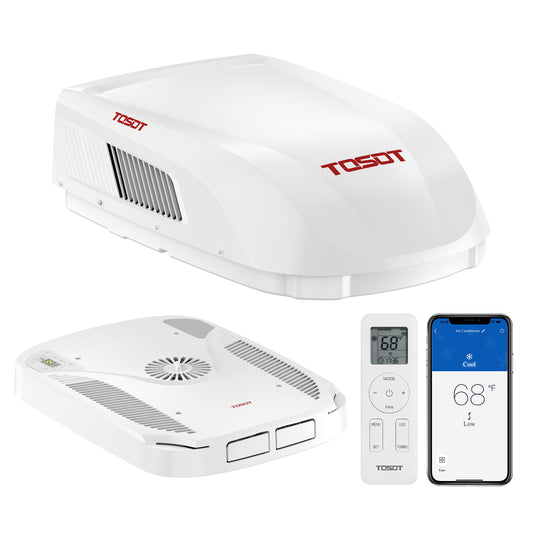
The TOSOT 16,000 BTU RV Air Conditioner is built for medium to large Class RVs up to roughly 650 sq. ft. of non-ducted space, so sizing it to your actual footprint matters more than sizing it to your RV class alone.
Understand Startup and Standby Power Consumption
A lot of RV owners overlook the power a unit pulls when it's technically "off."
- Standby power: Only 2W, so it won't quietly drain your battery bank overnight off-grid
- Running draw: 1550W rated input at 12.5A
- Soft start compatibility: With soft start, the startup surge stays manageable enough to run on smaller generators, including 3kW models, without tripping breakers
Use Fan Speed Strategically
Full blast isn't always the most efficient setting. High fan speed cools the cabin faster, but once the cabin reaches your target temperature, lowering the fan speed maintains comfort with less draw.
Additionally, on low-speed operation, TOSOT RV AC runs as quiet as 43 dB — useful for overnight running when you want quiet and efficiency, not just cold air.
Know Your Real Daily Consumption
It helps to plan power budgets around actual numbers rather than guesswork. Knowing how many kilowatt-hours (kWh) your air conditioner uses each day makes it easier to size your battery bank, solar panels, or generator. Under standard test conditions, the TOSOT 16,000 BTU RV Air Conditioner consumes approximately 4.8 kWh per day.
*Actual consumption varies with ambient temperature, insulation, and usage patterns.
Don't Overlook Heating Efficiency
Energy-conscious RVers often think only about summer, but a heat pump unit like this one is rated for 12,000 BTU heating down to 23°F operating temperature. It means you're not hauling a separate space heater or running a propane furnace constantly on shoulder-season trips.
The Bottom Line
Reducing RV air conditioner energy use isn't about sacrificing comfort—it's about making smarter choices. Improving insulation, cooling early in the day, selecting the right-sized air conditioner, and understanding your power consumption can help extend battery life, reduce generator runtime, and keep your RV comfortable wherever you travel.
Want to see how it installs, or whether a soft start is right for your setup? Check out our guides